
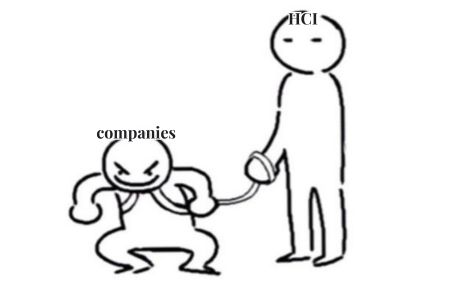
In my last blog post, I said “We must hold companies accountable for the message their medium is sending us.” However, I never offered a suggestion on how to go about doing that. In The Social Dilemma (2020), many folks who were involved in the development of popular platforms (e.g., Twitter and Facebook) were asked what exactly is the problem with said platforms but, despite their desire to warn people, were unable to answer. There’s not one singular issue; it’s in the multiple and thus hard to fit under one umbrella term. Similarly, I could not think of one solution that could resolve all the issues companies have caused. That is, until I read Doug Eyman’s (2015, pp. 55-60) section on human-computer interaction (HCI).
In it, Eyman argues for fields such as digital rhetoric, critical code studies, and HCI to research collaboratively. By introducing each field to show their similarities, he makes a convincing point on how they can benefit each other. It was the field of HCI that caught my attention.
HCI’s Potential Influence on Companies
Dix, Finlay, Abowd, and Beale (1993, p. xiii) say that HCI is “the study of people, computer technology, and the ways these influence each other.” H. Rex Hartson (1998) takes this definition but specifies further that HCI is
a field of research . . . with the objective of designing, constructing, and evaluating computer-based interactive systems . . . so that people can use them efficiently, effectively, safely, and with satisfaction. (103)
We can clearly see a focus on the people—the users—in the field of HCI. They even make it clear that they want people to use “computer-based interactive systems” safely. Thomas Skeen (2009), while pointing out the resemblance between HCI and digital rhetoric, agrees that this is a significant trait in HCI:
[T]he HCI field also concerns itself with user-centric empowerment as an ideal. As they consider the user’s wants and needs, an ideal of democratization and empowerment exists in both fields. (102)
This is a sentiment that’s very much needed in the companies who develop the platforms we use. Thus, a possible solution to the issues companies have caused might be HCI. In particular, I think people in the HCI field should be implemented to work in all these companies. Although they are unlikely to completely undo the embedded focus of surveillance capitalism, they could act as regulators. Returning to The Social Dilemma, there’s a clear push from users for platforms to not be as they are. Many of us recognize (how) they are causing damage. And HCI workers could and would force companies to make platforms more so with their users in mind, not money.


Leave a Reply