
Visual rhetoric is when images, colors, symbols, layouts, photos, typography, graphs, etc. are strategically used in digital spaces to communicate, persuade and evoke emotions to its viewers, and in turn, enhance a message to users and customers. In the chapter titled “Visual Rhetoric” of Doug Eyman’s 2015 book “Defining and Locating Digital Rhetoric,” he examines that Charles Hill and Marguerite Helmers point out the ambiguity of placing one concrete definition for what visual rhetoric is, as told in their 2024 text Defining Visual Rhetorics. Apparently,
“even within the community of rhetoricians who claimed the visual as their object of study, there seemed to be very little agreement on the basic nature of the two terms visual and rhetoric. To some, studying the “visual” seemed to consist solely of analyzing representational images, while to others, it could include the study of the visual aspect of pretty much anything created by human hands— a building, a toaster, a written document, an article of clothing— making the study of “visual rhetoric” overlap greatly with the study of design. To still others, the study of visual rhetoric seemed to necessarily involve a study of the process of looking, “the gaze,” with all of the psychological and cultural implications that have become wrapped within that term. (ix)”
What is Visual Rhetoric?
In a theoretical sense, visual rhetoric functions as in scholarship and practical fields, pulling from diverse disciplines to interpret how symbols convey meaning and persuade intent beyond fluffy aesthetics. In a historically developmental sense, scholar Roland Barthes examined how images work through denotation and connotation in his 1977 text “The Rhetoric of the Image,” asserting that cultural context often anchors pictures for a secured shared message to its viewers. In Linda Scott’s “Images in Advertising: The Need for a Theory of Visual Rhetoric,” (1994) she argues that pictures are not merely perceptions, but symbolic artifacts shaped by cultural conventions, mirroring rhetoric’s focus on human Visual Rhetoric and Digital Media
In Mary Hocks “Understanding Visual Rhetoric in Digital Writing Environments,” (2003) she observes and connects that digital rhetoric takes on “the use of visual methods because modern technology [as seen from an early 2000’s perspective] constructs meaning through verbal, visual, and interactive hybrids.” While critics such as Ian Bogost (2007) warned that regulated media like video games, challenge traditional visual analysis, implying that code and process easily replace static imagery. All and all, visual rhetoric stands as a foundation for studying how multimedia (images, text, sound) combines digital environments (memes, social media) to create and evoke meaning.
Advertising is a major example of the complexities that visual rhetoric holds in evoking emotions for audiences. For example, the donkey and elephant, which represent the U.S. Democratic and Republican parties, as well as the colors red and blue for the two symbols.

A Donkey’s Democratic Origin Story:
The trademark political symbolism of the donkey and elephant initially developed from mocking presidential candidates. In 1828, Andrew Jackson was labeled a “Jackass” during his presidential candidacy. Other than getting upset, he ran with the idea, relating donkeys as dependable and stable creatures. Down the line, a cartoonist named Thomas Nast popularized the imagery by making it the party’s official mascot. The transformation made the donkey an emblem for association with the Democratic party forever.
An Elephant’s Republican Origin Story:
The Republican elephant’s journey began in 1854. The creation of the “Grand Old Party” or “GOP” – the conservative party we know today – promoters of social conservatism and gun slinging – emerged. It gained popularity as Nast’s 1874 cartoon “The Third-Term Panic” depicted the elephant trapped to portray political anxieties whirling around Ulysses Grant. Other artists took that caricature and ran with it by 1880, and people began to associate it as the identity for the Republican party.
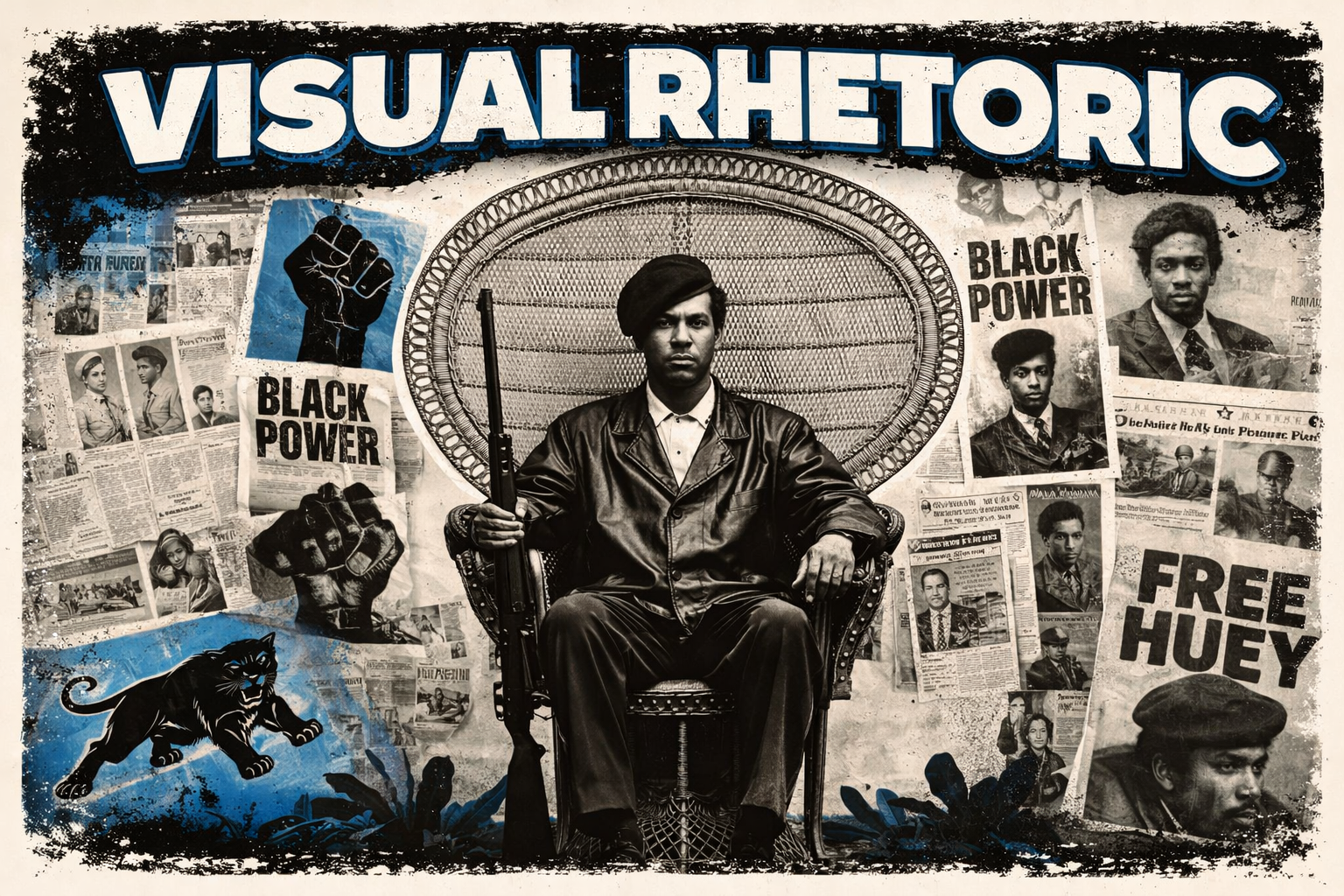
Other examples include associating the pink ribbon for breast cancer awareness, red for HIV/AIDS and heart disease, blue for child abuse/prostate cancer, gold for childhood cancer, and teal for ovarian/cervical cancer. One can also add the check symbol with the phrase “Just Do It” that Nike uses, McDonald’s Golden Arches symbol. My favorite example of visual rhetoric is a photo of the late great Dr. Huey P. Newton, Black Panther Minister of Defense. Photographed by Blair Stapp in 1968, this iconic, photo shows Newton

“sitting in a rattan throne chair wearing a beret and a black leather jacket while holding a shotgun in his right hand and a spear in his left hand. Leaning against the wall on either side of the chair is a leaf-shaped, Zulu style shield with designs of horizontal line markings across the front. Beneath the chair is a zebra print rug.”
People who have knowledge about the Black Panther Party, Pan-Africanism and the injustices of Black Americans see this photo and instantly, or at least I do, associate it with the Black Panther party, Black Power, Pan-Africanism and Newton’s legacy.
Conclusion
Simply put, advertising utilizes visual rhetoric with logos, colors, artwork, photos, graphs, or any other type of visual rhetoric devices so that you can always spot their signature branding. This is why big companies are beyond recognizable; day one supporters can spot style and come back time after time for more goods and services that they provide, all because they tend to keep a reliable, recognizable and easy flowing template to remember.


Leave a Reply