
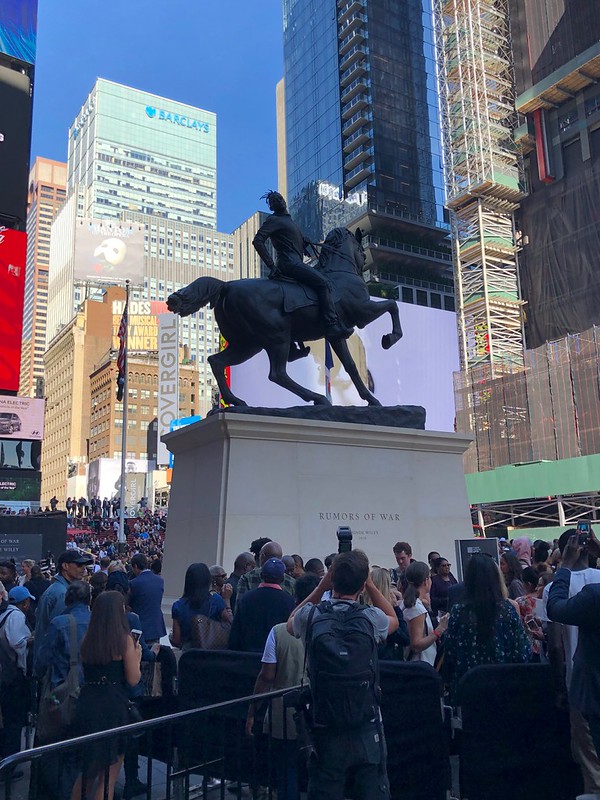
Featured image: ““Rumors of War”” by VCU Capital News Service, CC BY-NC 2.0
Happy Halloween! It might be a holiday but there still needs to be a blog post. This week I selected “Digital Writing and Cultural Rhetorics Pedagogies” by Kimberly Williams, T. Allen Thomas, Alexander Slotkin, Ivette Rodrigues, Claudia Mitchell, Nicole Green, Laken Brooks, Laura Gonzales. Big collab this time.
In their essay, the authors argue that digital writing and cultural rhetoric should be threaded together in pedagogical practice. Recently there has been an increase in programs promoting a connection between digital and cultural rhetoric. Not just from academic interest, but also from the Black Lives Matter movement and the COVID-19 pandemic. The authors want to bridge both digital and cultural pedagogy. They believe it can can help bring healing and reflection in both classroom and community contexts. They also argue against the idea that digital technology is the most effective or “progressive” form of communication. Angela Haas is cited on how Native Americans used Wanpum as a form of communication by using their beads to encode information.
The authors give examples and stories of pedagogy back when they teaching a semester in the Fall of 2019. This course, called “Digital Writing and Cultural Rhetorics”, included both MA and PhD students from multiple specialization areas within English studies. These classes involved tracing both the students and the instructors experiences defining and adapting definitions of and orientations to digital writing and cultural rhetorics pedagogies. At the beginning of every class, they would discuss the definitions from each week’s reading. They took notes of these definitions on a shared Google doc. On this doc, students were also told to post their reactions to the various readings. They would make connections between each of them. Each student had to comment on each other’s response to expand the conversation.
The biggest parts of this course were the pedagogical activities. They’re meant to put the concepts and ideas of the course into practice. These serve as a point of connection between digital and cultural rhetoric. Alexander Slotkin’s activity is “Black Out Poetry”. What you’re supposed to do is you take a pre-existing written text and blacking out most of the words. This would only leave behind a select few. The remaining words form a new passage with a new meaning attached to it. Slotkin likes this because it’s an accessible and adaptable learning tool. It can be amendable for non-normative bodies and non-neurotypical brains.
Ivette Rodrigues’ activity involved pictures. Students would draw two different pictures that represents an aspect of their identity on see-through paper. Then you superimpose both images onto one sheet and explain how these pictures change when bringing these identities together. One example Rodriques gives is how one drew picture of a lion surrounded by fire and another of a medal shot by an arrow. These pictures represent the challenge between the desire for personal achievement vs the need to remain grounded. When superimposed, the image represents the reality of human identity. Rodrigues likes this one because it shows how new cultures form from contact between different people and situations.
T. Allen Thomas chose an activity involving index cards. Each student picked a few cards and they would write a series of keywords or phrases from their course readings. Students were to find commalities in the keywords and combine them as many times as possible. Then, the students took a card from the leftover pile and place it on top of an existing keyword/phrase and then make a connection between the two keywords/phrases. Finally, the students have to select one language like Spanish and translate one keyword/phrase. This is for the students who can only speak one language to translate an unfamiliar phrase in their own words. Thomas likes this one because it can show how meaning changes between audiences and what could be easily understood may not be the everyone.
Kimberly Williams chose an activity involving monuments. More specifically, counter-monuments that fight back against monuments that are symbols of hate. Williams first gave examples of various pre-existing counter-monuments like Rumors of War (a counter to the confederate statutes) and After Anarcha (a counter to the statues of J Marion Sims, who experimented and dehumanized many black women). After the explanation, Williams tasked students to craft a blueprint based on alternative or otherworldly artifacts against systemic oppression. The student can utilize collaging, drawing, and coloring and included the consideration of sensory, placement, and community engagement.
My Thoughts
So I got a little to say in so much time (wait no, strike that, reverse it), so let me go over the parts I think the most worth talking about.
First of all, this authors talk about how every week their students would read something and discuss it with their thoughts and opinions. Sound familiar? Well I’m not really discussing this directly with other people in my blog because that’s not exactly how blogs work. Sure, people can comment on my posts and I can respond to said comments. The point of blogs is more to post updates, opinions, and essays. Writers are not expecting to have discussions on their blogs. That’s more for other places. For me, I do actually have discussions what I’ve read but those are physically in my classes.
Summarizing and giving opinions is chicle, but there’s a good reason teachers and professors. It’s show that we read and understood the work and didn’t sit around playing Fortnite or watching TikTok. I do make the effort to summarize what I read at the beginning like you read earlier. It’s why I summarize each reading at the beginning of my posts for two reasons. 1. If you don’t want to read the whole, I can show you the most important parts so you understand what I’m talking about. 2. This is show that I actually read the text and not just saying random stuff. I also make the effort to have a constant theme running by making connections to my past blog.
That is something that the essay brings up. The authors wanted their students to make connections between their readings. While I’ve never (at least not yet) been told to do that, I try to make some connection between my past blogs to show a unifying theme of digital rhetoric. This time I don’t even need to search for the connection because the authors outright made a connection for me.
I think this is the first time a work I read for these posts outright cite a source that I covered in a earlier post. That source being Angela Haas’ Wampum as Hypertext, which was actually my first post on this site. I’m probably wrong as I’ve read a lot of stuff over this semester, but at at least this is the first I noticed it.
Now I want to talk about the pedagogy activities. Black Out Poetry was the one that caught my attention the most because unlike the other three, I actually have some experience in that field. In fact, last week I had another class who wanted to take a text we read and black it out. My work is nowhere as good as the ones that Slotkin showed primarily because I only do when there assignment and also, just my disinterest in poetry. As much as I love to write (I already made it to 1200 words at this point), I hate poetry. I respect many poets but my brain renders their work as pretentious and verbose when it’d be easier to use simpler language.
Thomas’ activity of using index cards to make connections did get me thinking a bit. I tried thinking if I’ve done something like that before. Something in my head is telling me that I’ve done it multiple times but I can’t think of a specific example. So if I did, I probably did it back in elementary school. I did do something similar to that in this very class. We had to draw pictures of various topics we read about earlier in the semester like intertextuality and hypertext on a whiteboard. We then had to draw and explain the connection between these pictures. Which actually leads to the next activity.
Rodrigues’ activity intrigues me. It reminds a bit of the whiteboard assignment in that you draw pictures to have a unifying meaning but I consider that be closer to Thomas. With Rodrigues, the pictures have different meanings apart and have a completely new meaning when together. That’s not what I felt when I was drawing. We had to explain it, yes, but it seemed like we had to do it to understand what we were talking about. It is an interesting concept, and I’m pretty sure I’ve never done it before. I’m curious to try something like this out. Whether it be as a student or even if I use on the chance I become a teacher.
Now Williams’ activity intrigued me the most. I had never heard of the concept of counter-moments before. I’ve heard of people taking down offensive monuments like those confederate statutes. But a monument that faces a still-standing offensive monument never came to my head. I’m amazed to see what these people have made like Rumors of War and After Anarcha, to fight against oppressive symbols. I couldn’t see myself doing something like this because I’m not much of an architect or sculptor or painter but I fully support who do this. I’m very much all for designing art that stands up for justice and the greater good.
And that’s everything I have to say. I want to wish everyone reading this a happy Halloween. Although most of you are probably reading this after Halloween so in that case, happy belated Halloween. I’ll see you all next week!


Leave a Reply