
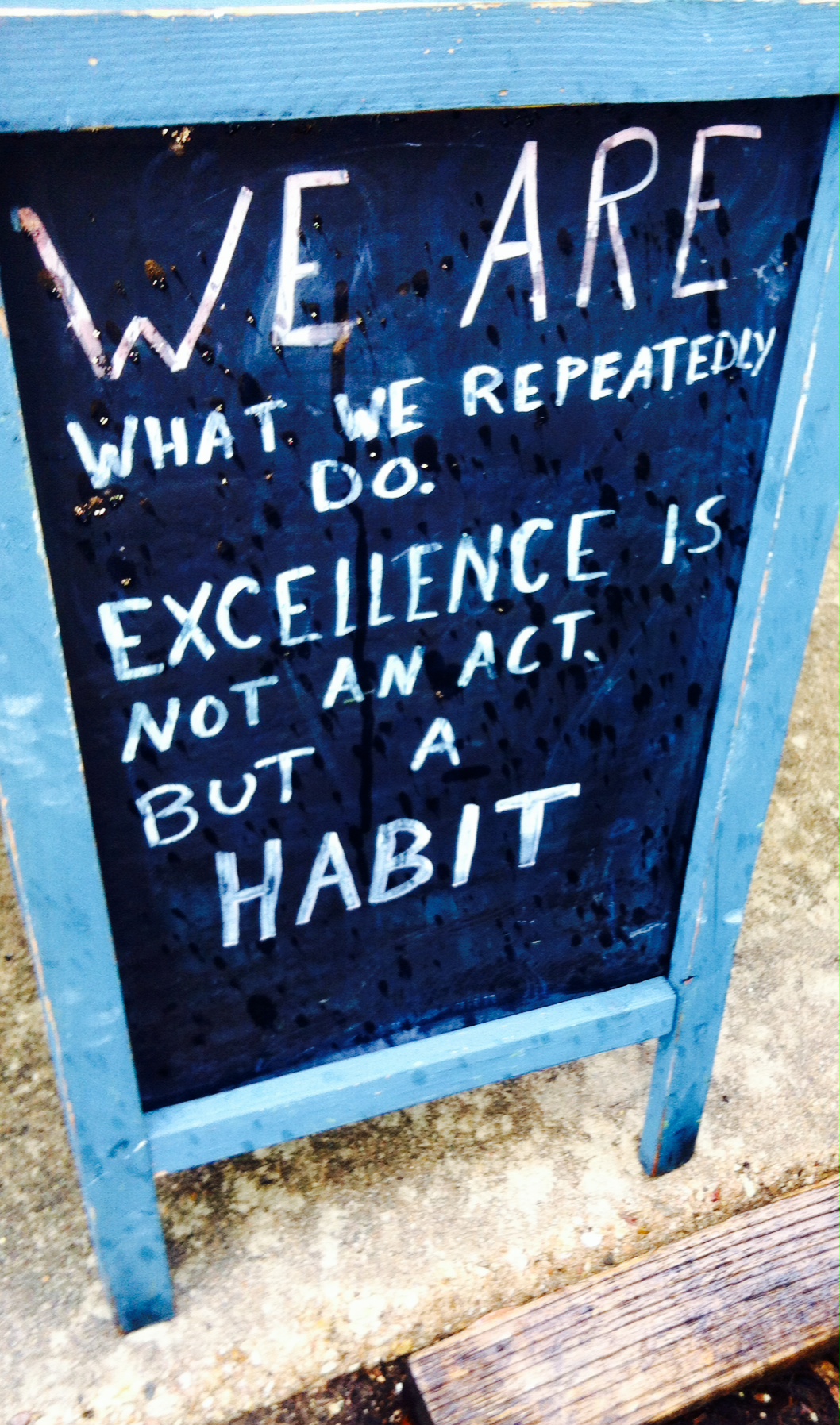
Feature image: “#habit” by lee leblanc, CC BY 2.0
The reading I chose this week is Ethos, Hexis, and the Case for Persuasive Technologies by Steve Holmes. In his essay, Holmes argues that behavior change can be digital rhetoric. Holmes feels that people focus too much on the persuasion in digital media with the language, the arguments, the social conscious. People treat them less as rhetoric and more as manipulation to create habits but not really get you thinking. Holmes believes that the physical environment and repeated actions help shape who we are.
An example he gives outside of the digital space is shopping locally vs at big box stores. Now when someone shops locally, you would probably assume that this person is doing the moral thing by supporting local businesses. While that’s likely one of the business, it’s many times not the only reason. Other factors can be public transportation, work and family schedules, automobile ownership, weather, parking availability, and many more. Do we dismiss these factors as manipulation?
There are two ways to look at habits. First, there’s the mechanistic way. Habits are viewed as disruptions to our freedom of thought and leads to thoughtless repetition. Then there’s the ontological way. Habits are an important part of a person as they shape how that person thinks and acts. Habits are neither good nor bad, but just a person’s way of being. Holmes focuses more on the ontological way.
He cites Ingrid Richardson who suggested that while given a mobile device that has the same system protocols, interface, and physical design, we all have unique habits that we use our devices like bowing our heads to hide ours face, shielding our mouths with our hand, or not altering our visual/facial orientation, and directing our gaze into the middle distance. Richardson believes that these habits are produced by embodied and spatial means from our own bodily practices to the physical design of these technologies, and by social forces.
Holmes also cites Jason Farman, who the latter gives an example of how one view the same Wikipedia content on a desktop at home vs on a phone sitting in a train, but the difference in the environment at home vs on a train will give you different habits when looking at Wikipedia. Farman also believes that your class, race, publicness, privateness, and gender can influence your habits online.
Holmes cites Katherine Hayles, who believes that technology shaping our minds is unavoidable as they enable new rhetorical practices by forming new habits of reading and communication. Nicholas Carr shares a similar view. He writes that when the same experience is repeated, the links between our neurons grow stronger.
My Thoughts:
So there’s a lot to this essay, but this is simplest way I can break down with the most important key points. Now this is the first time, I’ve really read about behavior change in digital rhetoric. So I can’t say if I 100% agree behavior change in digital media is actual rhetoric or just flat out manipulation.
I do believe Holmes makes good points in that habits while not always good, are not always bad either. My views more align with the ontological approach, in that I think we all have habits. Some benefit us while others hold us back but nobody’s perfect.
I also agree with Holmes that not everyone be persuaded to do something because it’s morally the right thing to do. In fact, I believed most people do things that that will only benefit them personally. An example I like to bring up in politics. Without naming names, when people vote for politicians, the main reason is never because they’re a friendly face for everyone. No, it’s usually because they’ll make more money under them. Lower taxes, government welfare, funding for areas they work in, and so many more.
I do agree with Holmes to least some extent that rhetoric is more than just what we say. I would need to do some more research and hear other opinions before I would give a formal opinion. One last thing I will say that it’s great to hear from less common points of view and the challenge the norm. It makes us all think. Like a form of rhetoric (although in this case, this more traditional).


Leave a Reply