
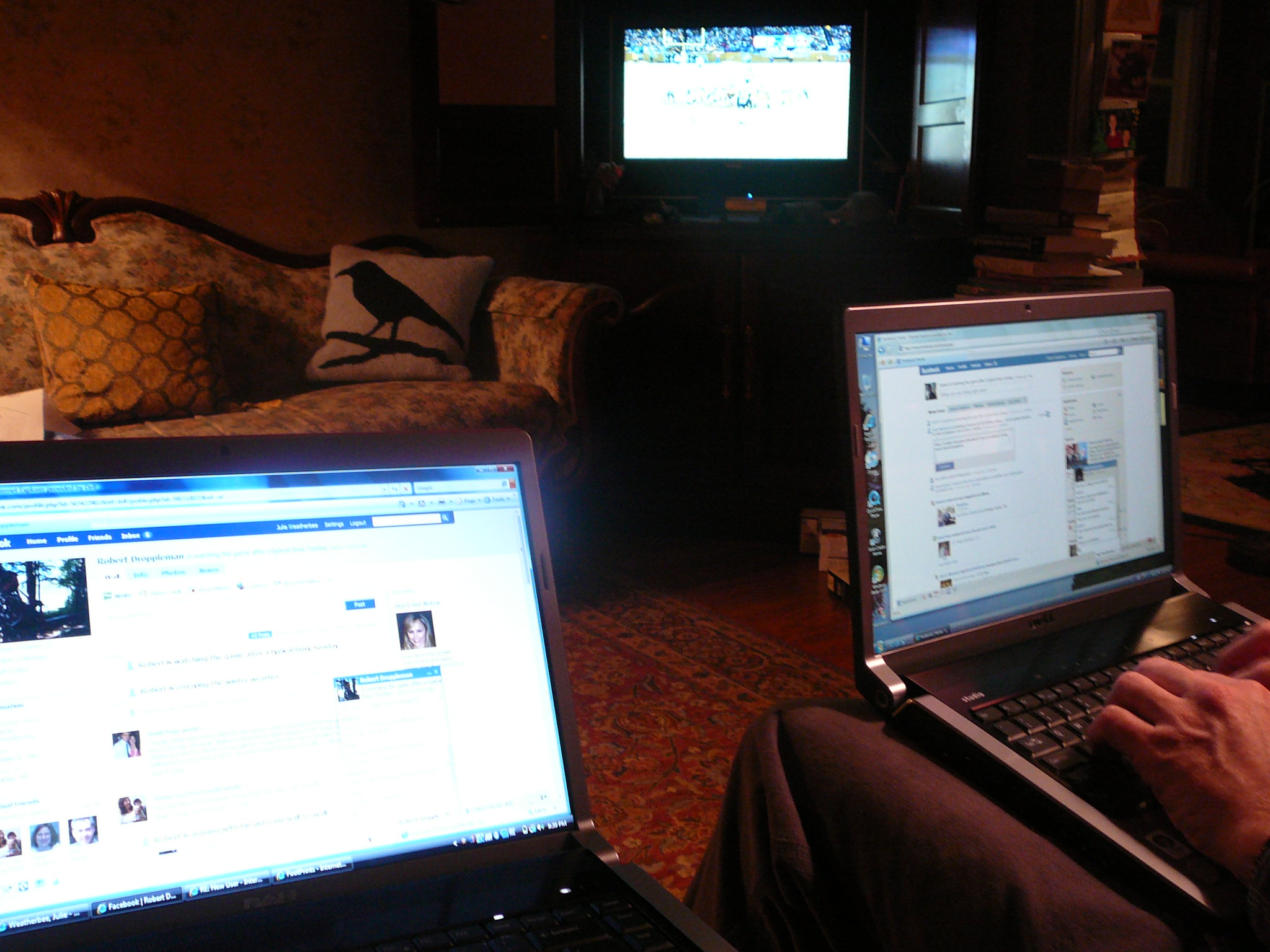
Featured image: “Geeks at Home” by Julie Weatherbee, CC BY-NC-SA 2.0
This week I chose to read Sneaky Rhetorics, Habitual Media, and the Affective Politics of Lurking on Facebook by Maggie Fernandes, Matthew Homer, and Jennifer Sano-Franchini. I chose this one because this focuses on social media addiction, something I and many others have a problem in.
The authors write about what they call “sneaky rhetorics”, a form of mistrust that occurs when one’s indulges in too much social media. This will encourage that person find more information online. They believe that these sneaky rhetorics create and amplify misinformation online, distract social media users to uphold their ideologies and benefit these media corporations. Social media sites like Facebook are known to create a wide variety of negative emotions like anxiety, loneliness, jealousy, depression, and the fear of missing out.
One term that the authors took note of is “Lurking”. Most people describe Lurking as when you’re browsing through other users posts but you don’t really contribute to them. You don’t like them, you don’t repost, you don’t comment. You just take a loot at it and move on to the next post. The authors argue that lurking actually is a form of sneaky rhetorics. While you’re not directly contributing to these post, you are still viewing them and taking in that information. Said information can still ignite emotions in you and can be why people prefer to lurk but not grab attention. One reported stated that as a user’s anxiety increased, so does their lurking. One form of lurking they took note of is “doomscrolling”. It’s described as when you’re constantly reading through various negative news online. Usually people do it to mitigate anxiety during moments of tragedy.
The authors decided to experiment on this concept. They would record all of their activity on Facebook from November 17 to November 23. For every interaction they did, they would record the date, time, duration, the type of interaction, the emotions they were had through that interaction, and if that interaction prompted them to do another action like clicking a link or messaging a friend.
At the end of the week, the authors found some interesting results. All three of them noted that they had a tendency to open Facebook without them really thinking about it. They often do this when they were waking up, waiting between their activities, or they were just bored. Another thing they noted was that the feelings they wrote would often sound contradictory. They would write how they were annoyed or confused but also curious and interested. Embarrassed but nostalgic. Anxious and self-loathing yet feeling a desire for engagement. Sano-Franchini went as far to say that Facebook felt like a waste of time and even dangerous. Yet, she still found it addictive.
Something that also caught their attention was that they got involved in plenty of lurking. Fernandes wrote about how she would frequently lurk on her friends’ account after looking at their posts, which she frequently found annoying. Fernandes and Sano-Franchini also noted about when they would see a post that caught their attention on their feed. Rather then like, comment, or repost it, they would message each directly to talk about it.
My Thoughts
So like my last post, this one also wordy but I was able to understand this one a bit better. Primarily because I knew plenty about the concept before I read this. I would say I agree with the authors on the idea of sneaky rhetoric. When we indulge in something too much, it becomes like a drug. It hurts us but yet we still want more. I believe these companies are designing their platforms in ways that we stay on longer (in fact I’ve essays in the past about social media companies keep their users hooked).
As I said at the beginning, I chose this article because it because on the concept of social media addiction. I don’t want to sound so above all, but I think I don’t have it as bad as other people. Despite that, I still think I have a problem. Similar to the authors with their Facebook, I have a tendency to open my Instagram whenever I’m bored or even waking up (although for the latter, Safari and Spotify were more likely to grab my attention). I don’t use DMs often though. I only use Instagram DMs whenever I don’t have that person’s phone number.
Lurking and Doomscrolling where the two things that made my thoughts go from “this sounds interesting” to “I actually want to write about this”. Pretty much my ventures on social media, whether it be Twitter (or X if you’re one of those guys), Instagram, or even YouTube, is that I look at them, and then move on. Reposting is not much of my thing to begin with. I don’t like to comment unless I feel like I can add discussion. Maybe if there’s a joke I really want to make.
Even liking is not something I do a lot unless it really stands out to me. I don’t even like using short form video makers like Instagram Reels and YouTube Shorts. I find them too gimmicky. As for doomscrolling, many people my age know what that is. For me, it’s mostly bad on Twitter. When I stay there for more than 5 minutes, I fall down a political rabbit hole. I managed to subdue on other platforms so the worst I’ll get on Instagram is mostly AI-slop.
Still though, I agree that lurking still contributes to rhetoric and not just because it can still influence your emotions but also because these platform will take note of you looking at posts even you do nothing else with them. For instance, I’ll look at one post on Instagram that one of those AI generated “solve the riddle” quizzes like “find the missing letter”. I look at it for more than 10 seconds just to see what it says and then move on. Then for the next few days, it just full of AI generated quizzes.
While I understand the reasons why the authors used Facebook for their research, I wish they put some more focus on other platforms like Twitter and Instagram. Somewhat because of personal bias as I use both of them but not Facebook, but also because by 2019, many younger generations preferred using those over Facebook so I think doing experiments on those sites could help relate to younger readers. Especially since the week they chose to do the experiment overlapped with a political debate and people see Twitter as an ever bigger toxic cesspool for politics.
If there’s one more thing I’ll add, is that I think it would be interesting to actually record my own social media activity with my thought and emotions and much I use these platforms. Similar to how I jot down the comic book I’ve read, and want to read in the future. The only problem is that I’m so busy with my assignments in this class plus the other classes right now so I don’t really have the time to focus on something more on my own. Maybe once I finish my semester I can try something like that.


Leave a Reply