
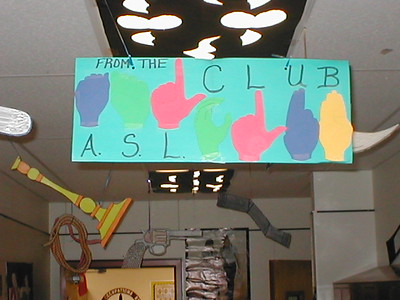
Featured Image: “ASL hall sign” by Swenda, CC BY-SA 2.0
Another week has come, so you know what that means. This time, it’s Where Access Meets Multimodality: The Case of ASL Music Videos by Janine Butler.
In this article, Butler demonstrates how American Sign Language (ASL) music videos can enhance accessible multimodal pedagogies. She believes that ASL music videos can show how synchronizing multiple modes (like visual, digital, and gestural, among many other modes) can strengthen the aesthetic and rhetorical message of a composition and increase the chances of their meanings being accessed by those who wouldn’t be able to traditionally.
At first you assume that ASL music videos are just using the traditional subtitles you can find on most YouTube videos. There’s a few problems with though. It’s just a bunch of plain, white text that will sometimes cover the singer’s face. The biggest problem is that the subtitles are not synchronized. The lyrics will disappear while they’ll still being sung and then the next lines will appear being they’re being sung. ASL music videos involve adding color and changing the size. The text can be expanded, colored or bubbled to reflect the mood and spirit, or fade in and out in tune with the music.
An example Butler uses is an ASL friendly version of Owl City’s “Fireflies”. In it, the lyrics appear softly in sync with the singing voice and the signing body. One moment she takes note of is when the words “that planet Earth turns slowly” appear on screen. English and ASL don’t have the exact same grammatical structure. In this case, in ASL, the signs for “turns slowly” is actually the other way around. Because of this, the performer gives the sign for “slowly” while the voice and lyrics show “turns” and vice verse.
Another example Butler gives is “Let’s Mambo” by Sean Forbes. Forbes, who is deaf, stylizes the subtitles in various ways to the music. Various words and syllables grow larger and moved up above other words in the line to reflect the movement of the music. When deaf actress, Marlee Matlin appears, she signs the words “Let’s Mambo”. While that’s happening, the text that appears on screen becomes enormous, bubbled, and vibrant. When Matlin teaches Forbes how to dance, they count 1, 2, 3, and cha-cha-cha. During that count, various numbers and letters appear on screen, enlarged and color colored to match the sequence.
However, Butler believes that there are limitations to many of these ASL videos. Notably, she believes that a lot of these are made under the assumption that while the viewer is deaf, they can still easily read the subtitles.
One example that goes beyond words is an ASL version of “Hero” by Enrique Iglesias. While the usual subtitles are there, the focus is drawn towards the visuals. The camerawork is shot and edited in ways that reflect the lyrics. Scenes will slide in and out of frame as the lyrics dissolve in and out. In addition, deaf actor Sean Berdy shows off various gestures to express the tone of the song. Butler describes one point where Berdy is shown riding a bike with a camera pointed at him from the handlebars. While he’s pedaling, he’s riding his bike hands-free, which is meant to represent the potential of love in the song.
The last example Butler gives goes even further with an ASL version of “Beautiful” by Christina Aguilera. Unlike “Hero”, “Beautiful” does not have any subtitles. The camera doesn’t even show the faces of the performers, wanting to entirely focus on their signs. Butler takes note that not only do they create signs of words, but also makes gestures and even fingerspell towards other words. At one point, a woman smashes away several large words like “Dumb,” “Stupid,” and “Idiot” as Aguilera sings, “Yes, words can’t bring me down”. At the end of the video, each of the performers fingerspell the word B-E-A-U-T-I-F-U-L over the same letters in print typology.
There are still some other setbacks though. Butler points out a few times that these aren’t the best at appealing to blind viewers. She believes that these music videos should also have audio description that describes the signs, bodies, and the dynamic visual text.
Finally, Butler believes that ASL music videos can used to teach students about multimodal pedagogy. She uses an example from when she was teaching a composition class. First, she shows her students an ASL music video. After the video is done, she provides a handout to the students asking about the video’s context, content description, rhetorical appeals, key features, and accessibility. After the handout, the students break into groups to discuss the videos’ rhetorical and visual practices based on those questions. Finally, the whole class came back together to discuss their responses. Later down the line, Butler want every student to make an video on their own using what they learned about dynamic text. Once they’re finished, they’re asked to write a reflection about their video like who was the “intended audience”, “do you think it’s effective”, and “if there’s anything you would change”.
My Thoughts:
So the students do their reflection and now here’s my reflection. There’s a lot that I summarized but I have a lot to talk about so I wanted to summarize all the points I needed so it would make sense.
First of all, my relationship with ASL. Let’s get something out of the way now. I’m not deaf. I’m a high-functioning autistic but I don’t have a physical disability. I don’t personally know anyone who is deaf. The closet I’ve seen is that I know several people with speech impediments. Because of that, while I was aware of the existence of ASL before I read this essay, I don’t really what any of the signs mean.
Now the reason I chose this essay to begin with one, being autistic, I wanted to research more into disabilities outside of what I have. And two, the concept of ASL music video fascinated me. Now I’m a big music guy. At various points when writing this post, I’ve actually been listening to music. However, I’m not much of a music video guy. I think the fun for me when listening to music is actually conceptualizing your own videos in your head from how you interpret the song. An ASL music to me at first glance sounds counter-productive. Why bother to make a music video for a group that can’t hear the music to begin with. It just sounded to like a verbose way of saying that you added subtitles to the video.
Well, as Butler said, ASL music videos are more than just subtitles. The ways that the Deaf Professional Arts Network did to make ASL friendly music videos were pretty clever. Playing with the subtitles that color and size changes to the beat of the music. Having each word appear and then disappear on screen as the singer performs them.
It reminds me of this video from a YouTuber I watch called “Uncle Dane”. He does a lot of videos on the video game Team Fortress 2, particularly on the character of the Engineer. The video I’m thinking about is “How To Fight Every Class In TF2 (As Engineer) (And Win!)”. While not a song, the subtitles go beyond the usual ones you see on most YouTube videos. Various words are bold, italicize, or even put in a different color to either put emphasis on something Dane is saying or to signifying a in-game voice line or sound effect that should pay attention to. Dane’s video isn’t really ASL friendly as it makes multiple points about listening to the aforementioned voice lines and sound effects but the effort he put in his video reminded me of how Sean Forbes stylized the lyrics in his own video.
Even outside of just subtitles and signs, the gestures are something I wouldn’t think about at first if I made a music video. Like in the “Hero” video where Sean Berdy’s expressions enforce the themes of love in the song. Or in the “Beautiful” video, where in addition to the usual signs for words, the performers do several hand gestures against various hateful words. I love stuff like that. Moving beyond just the words and putting emphasis on the visuals. It reminds us that that these are still videos while still benefiting the deaf viewer.
It actually reminds me of another music video. This one being “Around the World” by Daft Punk. At first glance, it just seems like it’s just people in costumes walking in circles. However, if you’re paying attention to the song, you’ll that each costumed group is actually moving in tune with a part of the song. The skeletons represent the guitar, the mummies represent the drum beat, the robots are the vocals, the women are the synth, and the really tall guys are the bass. Like the Uncle Dane, this isn’t ASL friendly as video assumes that the viewer to be able to hear the song but this is a video that takes advantage of the music alongside the (very simplistic) lyrics.
While I usually prefer reading as I like the idea to create my own visuals in my head as opposed to being provided what they want you to see, there’s a reason that the film adaptation is usually more popular than the original book. To put it simply, people want to use their eyes to see a world. Not words that describe a world like a brochure. When people watch music videos, they don’t want to primarily read the on screen lyrics. They want to see what the people in the video do. Would the music video for “Take On Me” been so iconic if it was just a bunch of text on screen?
Now as for Butler’s lessons, I love that one of them is involves is actually making a video with dynamic text. It shows everything that the student learns over this course. And to add some personal bias, I love editing videos. Mostly I like to add audio as music and sound effects can turn a good video into a great video. Adding dynamic text helps the video too. Not only to help deaf people, and even just people who can’t hear well. It also helps add personality too. There’s a charm to see text fade in and out and grow big and small and change color.
And after all that, I think that’s all I have to say. Thank you all for reading and stay tuned for next week. I already decided the next article to write about but I’ll keep you all in suspense. Until next time, take care!


Leave a Reply